
Train Travel Payment Practices Report 2022
UK Train Travel Pays Suppliers Above Average, But Wide Disparities Persist
The Numbers
- Average PaymentCheck Score (9 companies): 62.8/100
- UK Average PaymentCheck Score (all sectors): 50.0/100
- Train Travel sector outperforms UK average by: 12.8 points
- Top Payer: MERSEYRAIL ELECTRICS 2002 LIMITED - 85.63/100
- Bottom Payer: HITACHI RAIL LIMITED - 45.5/100
- Regional Average (North West - 1 company): 85.6
- Regional Average (North East - 2 companies): 66.7
- Regional Average (London - 5 companies): 59.0
- Regional Average (East Midlands - 1 company): 51.0
What Stands Out
The UK train travel sector, on average, pays its suppliers more promptly than businesses in other industries, as demonstrated by a sector PaymentCheck score of 62.8, compared to the UK average of 50.0. However, the spread of scores – from Merseyrail's impressive 85.63 to Hitachi Rail's lagging 45.5 – reveals significant inconsistency in payment practices across train operators and their suppliers. Eurostar appearing in both the best and worst payers section indicates something is particularly inconsistent with their practices - possibly depending on which entity they work with.
Best Payers
- MERSEYRAIL ELECTRICS 2002 LIMITED - 85.63/100
- XC TRAINS LIMITED - 77.2/100
- TRANSPORT UK EAST ANGLIA LIMITED - 69.97/100
- WEST MIDLANDS TRAINS LIMITED - 69.7/100
- EUROSTAR INTERNATIONAL LIMITED - 58.75/100
Worst Payers
- HITACHI RAIL LIMITED - 45.5/100
- SIEMENS MOBILITY LIMITED - 50.9/100
- PANDROL LIMITED - 51/100
- THE CHILTERN RAILWAY COMPANY LIMITED - 56.1/100
- EUROSTAR INTERNATIONAL LIMITED - 58.75/100
Regional Patterns
There's a marked regional divide, with the North West (driven solely by Merseyrail) scoring the highest at 85.6, while the East Midlands sits at the bottom with 51.0; London's average is 59.0 across 5 companies, suggesting a mixed bag of payment performance in the capital. The small number of companies used to calculate these averages, particularly in the North West and East Midlands, means that these averages should be interpreted cautiously.
Suppliers considering working with companies that aren't meeting their payment obligations should check out this late payment calculator.
Despite an overall sector average that's above the national benchmark, the nearly 40-point difference between the top and bottom payers indicates a substantial risk for suppliers depending on who they're doing business with, emphasizing the need for due diligence before committing to a contract.
Read next
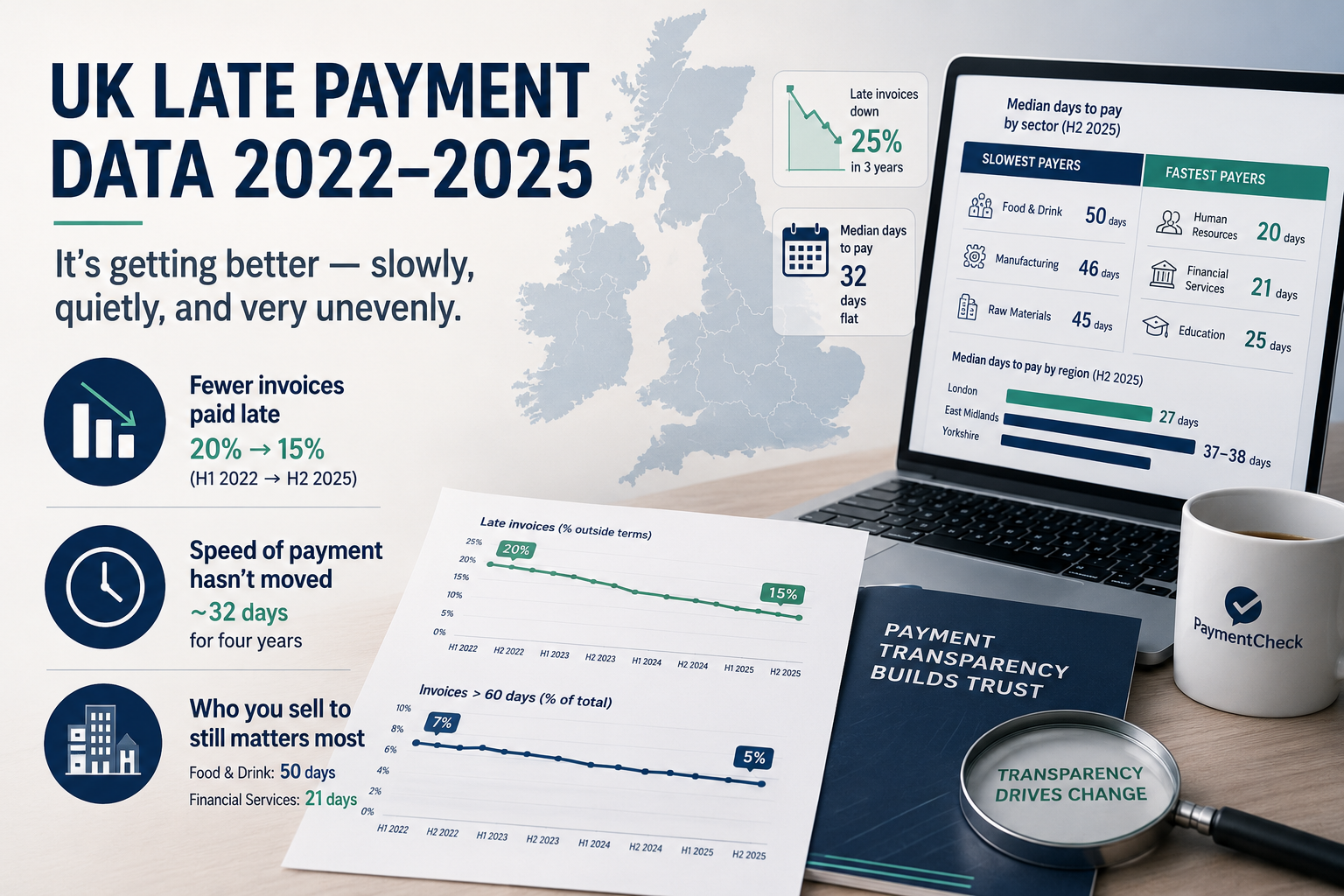
Late payment in the UK is quietly improving — but your invoice still depends on who you sell to
We analysed over 100,000 published UK payment-practice reports. Late payment is falling — from 20% of invoices paid outs
UK Company Payment Practices 2025: Biggest Risers, Fallers & New Entrants
How UK companies' payment practices changed in 2025 — the biggest improvers, the firms slipping, and the strongest new e
Agriculture Payment Practices Report 2025
The UK agriculture sector is significantly outperforming the UK average for payment practices, suggesting a degree of fi
Northern Ireland Payment Trends: 2024 vs 2025
The year-on-year decline of 0.1 points, while statistically insignificant, suggests a stagnation in payment performance