
Energy Payment Practices Report 2023
UK Energy Sector Payments Show Stark Divide Despite Overall Strength
While the UK energy sector demonstrates significantly better payment performance than the national average, a wide disparity exists between the best and worst payers.
The Numbers
- Companies analysed: 187
- Average PaymentCheck Score: 78.7/100
- UK average: 50.0/100 (Energy is 28.7 points above)
- Top PaymentCheck Score: 100/100 (multiple companies)
- Lowest PaymentCheck Score: 21.1/100
What Stands Out
The energy sector's average PaymentCheck score of 78.7 is a considerable 28.7 points higher than the UK average of 50, suggesting a stronger commitment to timely payments compared to other sectors. However, the presence of companies scoring as low as 21.1 reveals a significant performance gap within the industry. It's safe to say that some companies within the energy sector are performing exceptionally well and prioritising paying their suppliers on time, whilst others are falling far short.
Best Payers
- NEO ENERGY PATHWAY LIMITED - 100/100
- VITOL BROKING LIMITED - 100/100
- NEO ENERGY NATURAL RESOURCES LIMITED - 100/100
- WMR JV INVESTCO LIMITED - 100/100
- INNER DOWSING WIND FARM LIMITED - 100/100
Worst Payers
- BROOKFIELD GLOBAL RENEWABLE ENERGY ADVISOR LIMITED - 21.1/100
- CLARIOS UK LIMITED - 27.68/100
- ENSCO OFFSHORE U.K. LIMITED - 29.4/100
- ENERSYS LTD. - 30.8/100
- CRP SUBSEA LIMITED - 32.3/100
Regional Patterns
Regional averages don't offer much insight. While "Unknown" leads the way at 85.5, that's only based on two companies, so isn't really representative. London, with its larger sample size of 66 companies, achieved a solid 81.7, but there aren't massive deviations across the regions to write home about.
You can calculate any potential late payment fees using a late payment calculator.
The UK energy sector presents a picture of overall payment health, but with a sizeable minority of companies potentially causing cash-flow issues for their suppliers, indicated by the lowest score of 21.1 compared to the average of 78.7.
Read next
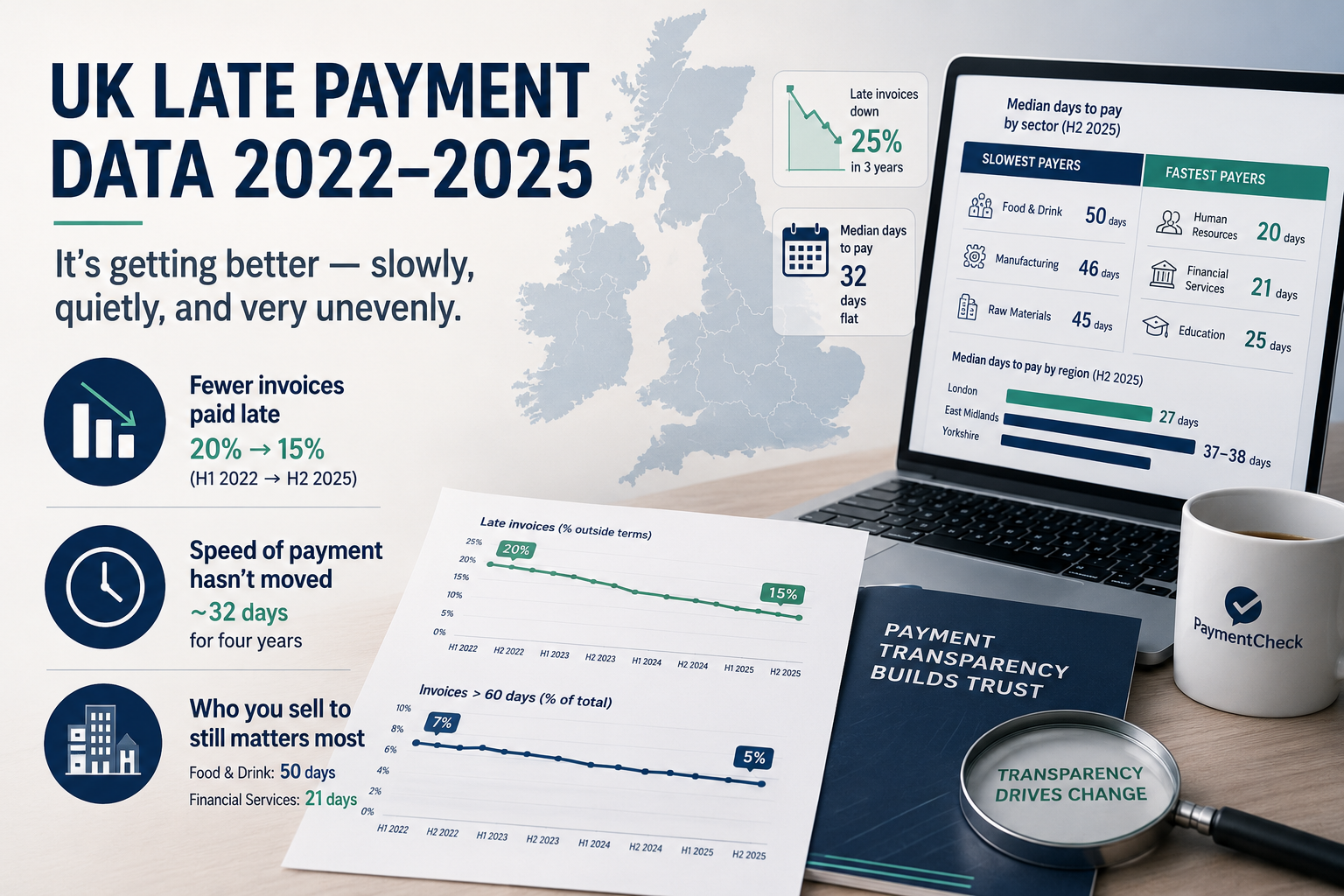
Late payment in the UK is quietly improving — but your invoice still depends on who you sell to
We analysed over 100,000 published UK payment-practice reports. Late payment is falling — from 20% of invoices paid outs
UK Company Payment Practices 2025: Biggest Risers, Fallers & New Entrants
How UK companies' payment practices changed in 2025 — the biggest improvers, the firms slipping, and the strongest new e
Agriculture Payment Practices Report 2025
The UK agriculture sector is significantly outperforming the UK average for payment practices, suggesting a degree of fi
Northern Ireland Payment Trends: 2024 vs 2025
The year-on-year decline of 0.1 points, while statistically insignificant, suggests a stagnation in payment performance