
Manufacturing Payment Practices Report 2025
UK Manufacturing Payments: A Mixed Bag in 2025
The Numbers
- Companies analysed: 156
- Average PaymentCheck Score: 53.1/100
- UK average: 50.0/100
- Northern Ireland average: 65.9/100 (2 companies)
- East of England average: 61.4/100 (11 companies)
- South East average: 58.6/100 (34 companies)
- South West average: 55.1/100 (12 companies)
What Stands Out
Manufacturing's average PaymentCheck score of 53.1 is marginally above the UK average of 50, but let's be honest, it's hardly setting the world alight. The spread between the best and worst payers is huge – Tata Steel scores a dismal 5.8, while Mitsubishi Heavy Industries EMEA hits a respectable 92.47, showing there's no sector-wide standard.
Best Payers
- MITSUBISHI HEAVY INDUSTRIES EMEA, LTD. - 92.47/100
- ATLAS COPCO LIMITED - 91.7/100
- DE LAGE LANDEN LEASING LIMITED - 90.6/100
- STANNAH LIFT SERVICES LIMITED - 89.9/100
- M GROUP SERVICES PLANT & FLEET SOLUTIONS LIMITED - 88/100
Worst Payers
- TATA STEEL UK LIMITED - 5.8/100
- SCHOELLER ALLIBERT LIMITED - 19.7/100
- GRAPHIC PACKAGING INTERNATIONAL LIMITED - 21.8/100
- COVERIS LOUTH LIMITED - 24.4/100
- ZF LEMFORDER UK LIMITED - 25.7/100
Regional Patterns
Northern Ireland stands out with an average PaymentCheck score of 65.9, significantly higher than other regions, although this figure's based on just two companies, so it's hardly conclusive; the South East has the most companies recorded and scores 58.6, higher than the average of 53.1.
If you're waiting to get paid, see if our late payment calculator can help.
Takeaway: With a sector average of 53.1 and a massive range of scores, payment practices in UK manufacturing are far from consistent, highlighting the need for suppliers to do their homework on individual companies.
2025: The Story
Manufacturing payment performance showed a modest improvement in 2025, with the average score rising by 1.0 points to 53.1/100, even as the reporting landscape shifted with 35 companies exiting the data. This positive aggregate trend obscures significant individual changes; for example, Luxfer Gas Cylinders Limited made a substantial leap, improving by 18.6 points to a robust 62.8/100, demonstrating a clear focus on better payment practices. At the other end, Coveris Louth Limited experienced the steepest decline, falling 7.8 points to a concerning 24.4/100, signaling potential cash flow or operational issues. The reduced number of reporting entities, from 183 to 156, suggests a possible consolidation within the sector or a thinning of the ranks of larger payers, which may have contributed to the overall score uptick. Suppliers need to scrutinise not just average scores but also individual customer data and the evolving composition of the reporting cohort, as these factors directly impact payment reliability.
Read next
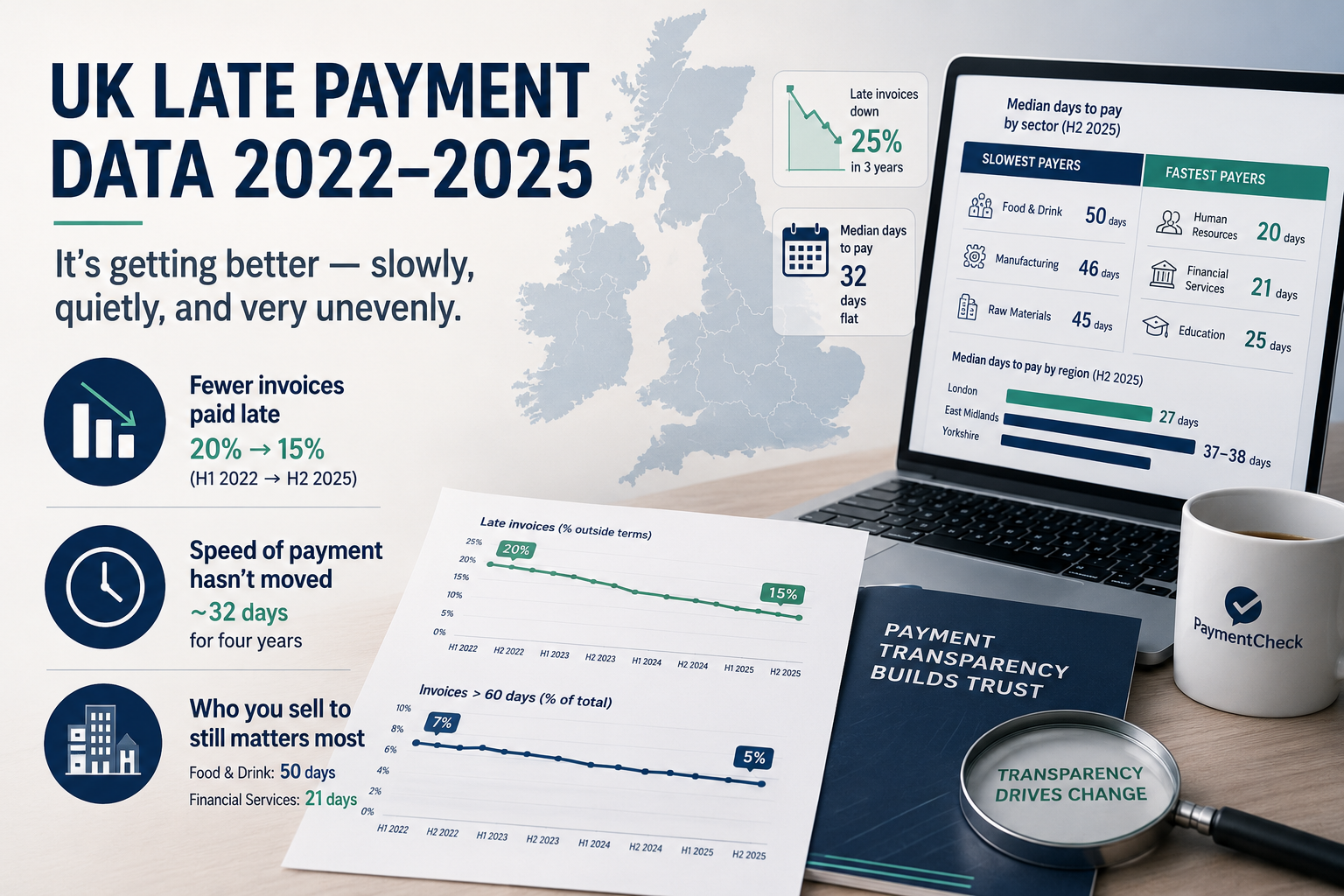
Late payment in the UK is quietly improving — but your invoice still depends on who you sell to
We analysed over 100,000 published UK payment-practice reports. Late payment is falling — from 20% of invoices paid outs
UK Company Payment Practices 2025: Biggest Risers, Fallers & New Entrants
How UK companies' payment practices changed in 2025 — the biggest improvers, the firms slipping, and the strongest new e
Agriculture Payment Practices Report 2025
The UK agriculture sector is significantly outperforming the UK average for payment practices, suggesting a degree of fi
Northern Ireland Payment Trends: 2024 vs 2025
The year-on-year decline of 0.1 points, while statistically insignificant, suggests a stagnation in payment performance