
Healthcare And Wellbeing Payment Practices Report 2024
UK Healthcare & Wellbeing Sector Shows Above-Average Payment Performance, But Significant Disparities Remain
The Numbers
- Average PaymentCheck Score: 65.1/100 (60 companies analysed)
- UK Average PaymentCheck Score: 50.0/100
- Healthcare & Wellbeing Sector Outperformance: 15.1 points above UK average
- Top Payer Score: 99.6/100 (Motability Operations Limited)
- Bottom Payer Score: 21.82/100 (Boots Management Services Limited)
- Regional Payment Performance Range: 76.8/100 (West Midlands) to 66.9/100 (South East)
What Stands Out
While the sector's average payment performance is notably better than the UK average, a wide range exists: some organisations are exemplary payers, while others fall considerably short. Boots Management Services Limited's PaymentCheck score of 21.82/100 is almost 80 points lower than the top payer, indicating significant payment issues within the organisation. You can use a late payment calculator to estimate the potential costs of slow payments.
Best Payers
- MOTABILITY OPERATIONS LIMITED - 99.6/100
- PHYLLIS TUCKWELL MEMORIAL HOSPICE LIMITED - 96.35/100
- OASIS DENTAL CARE LIMITED - 94.7/100
- PARTNERSHIPS IN CARE SCOTLAND LIMITED - 94.6/100
- J C CARE LIMITED - 94.3/100
Worst Payers
- BOOTS MANAGEMENT SERVICES LIMITED - 21.82/100
- PZ CUSSONS (UK) LIMITED - 22.83/100
- VIIV HEALTHCARE TRADING SERVICES UK LIMITED - 29/100
- TEVA UK LIMITED - 30.3/100
- MEDIGOLD HEALTH CONSULTANCY LIMITED - 33.8/100
Regional Patterns
The West Midlands leads in payment performance with an average score of 76.8, but with only two companies contributing to this average, it's hard to call it definitive proof of better payment practices in the region. London, with 18 companies, has a solid average of 70.1, while the South East (13 companies) lags behind at 66.9, which suggests that geography may, in some instances, play a role.
While the Healthcare and Wellbeing sector as a whole fares better than the national average for payment performance, with a score of 65.1/100 versus 50.0/100, the data clearly shows there are still some organisations lagging far behind, potentially putting a squeeze on their suppliers.
Read next
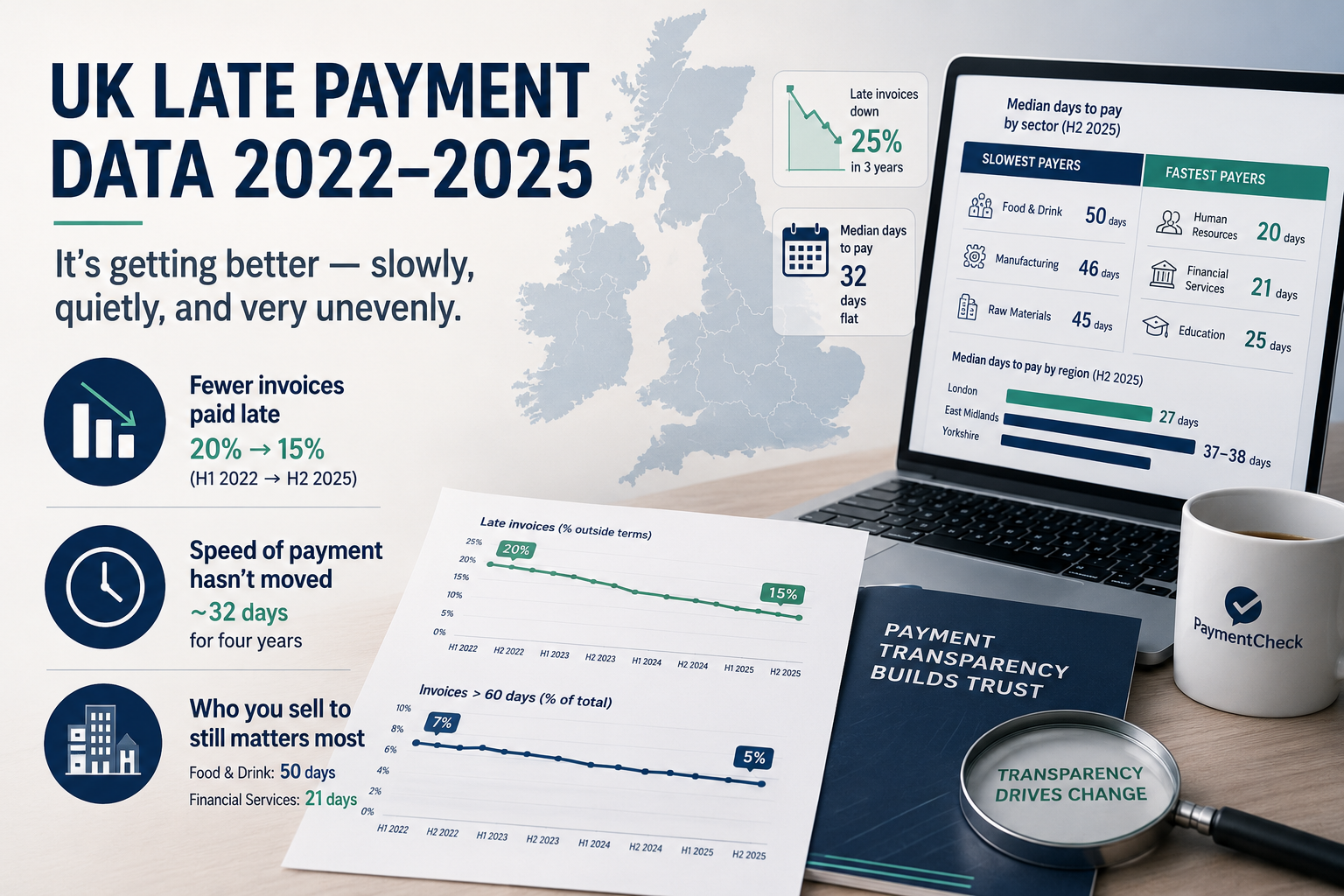
Late payment in the UK is quietly improving — but your invoice still depends on who you sell to
We analysed over 100,000 published UK payment-practice reports. Late payment is falling — from 20% of invoices paid outs
UK Company Payment Practices 2025: Biggest Risers, Fallers & New Entrants
How UK companies' payment practices changed in 2025 — the biggest improvers, the firms slipping, and the strongest new e
Agriculture Payment Practices Report 2025
The UK agriculture sector is significantly outperforming the UK average for payment practices, suggesting a degree of fi
Northern Ireland Payment Trends: 2024 vs 2025
The year-on-year decline of 0.1 points, while statistically insignificant, suggests a stagnation in payment performance